The IP address gives the attacker’s Internet address. The
numerical address like 212.214.172.81 does not reveal much. You can
use PING to convert the address into a domain name in WINDOWS: The
Domain Name Service (DNS) protocol reveals the matching domain
name. PING stands for “Packet Internet Groper” and is delivered with
practically every
Internet compatible system, including all current Windows
versions.
Make sure
you are logged on to the net. Open the DOS
shell and enter
the following PING command:
Ping –a 123.123.12.1
Ping will search the domain name and reveal it. You will
often have information on the provider the attacker uses e.g.:
dialup21982.gateway123.provider.com
Pinging is normally the first step involved in hacking the
target. Ping uses
ICMP
(Internet Control Messaging Protocol) to determine
whether the target host is reachable or not. Ping sends out ICMP Echo
packets to the target host, if the target host is alive it would respond
back with ICMP
Echo reply packets.
All the versions of Windows also contain the ping tool. To
ping a remote host follow the procedure below.
Click Start and then click Run. Now type ping <ip
address or hostname>
(For example: ping yahoo.com)
This means that the attacker logged on using
“provider.com”.
Unfortunately, there are several IP addresses that cannot
be converted
into domain names.
For more parameter that could be used with the ping
command, go to
DOS prompt and type ping /?.
Ping Sweep
If you are undetermined about your target and just want a
live system, ping sweep is the solution for you. Ping sweep also uses
ICMP to scan for live systems in the specified range of IP addresses.
Though Ping sweep is similar to ping but reduces the time involved in pinging a range of IP addresses. Nmap (http://www.insecure.org) also
contains an option
to perform ping sweeps.
Tracert:
Tracert is another interesting tool
available to find more interesting information about a remote host. Tracert also
uses ICMP.
Tracert helps you to find out some information about the
systems involved in sending data (packets) from source to
destination. To perform a tracert follow the procedure below.
Tracer connects to the computer whose IP has been entered
and reveals all stations starting from your Internet connection. Both
the IP address as well as the domain name (if available) is displayed.
If PING cannot reveal a name, Traceroute will possibly
deliver the name of the last or second last station to the attacker, which
may enable conclusions concerning the name of the provider used by the
attacker and the region from which the attacks are coming.
Go to DOS prompt and type tracert <destination
address>
(For example: tracert yahoo.com).
But there are some tools available like Visual Traceroute
which help you
even to find the geographical location of the routers
involved.
http://www.visualware.com/visualroute
Port Scanning:-
After you have determined that your target system is alive
the next important step would be to perform a port scan on the
target system.
There are a wide range of port scanners available for free.
But many of them uses outdated techniques for port scanning which could
be easily recognized by the network administrator. Personally I like
to use Nmap (http://www.insecure.org) which has a wide range of
options. You can download the NmapWin and its source code from:
http://www.sourceforge.net/projects/nmapwin.
Apart from port scanning Nmap is capable of identifying the
Operating system being used, Version numbers of various services
running,
firewalls being used and a lot more.
Common ports:
Below is a list of some common ports and the respective
services
running on the ports.
20 FTP data (File Transfer Protocol)
21 FTP (File Transfer Protocol)
22 SSH
23 Telnet
25 SMTP (Simple Mail Transfer Protocol)
53 DNS (Domain Name Service)
68 DHCP (Dynamic host Configuration Protocol)
79 Finger
80 HTTP
110 POP3 (Post Office Protocol, version 3)
137 NetBIOS-ns
138 NetBIOS-dgm
139 NetBIOS
143 IMAP (Internet Message Access Protocol)
161 SNMP (Simple Network Management Protocol)
194 IRC (Internet Relay Chat)
220 IMAP3 (Internet Message Access Protocol 3)
389 LDAP
443 SSL (Secure Socket Layer)
445 SMB (NetBIOS over TCP)
Besides the above ports they are even some ports known as
Trojan
ports used by Trojans that allow remote access to that
system.
Vulnerability Scanning:
Every operating system or the services will have some vulnerabilities due to the
programming errors. These vulnerabilities are crucial for a successful hack. Bugtraq is
an excellent mailing list discussing the vulnerabilities in the various system. The
exploit code writers write exploit codes to exploit these vulnerabilities existing in a system.
There are a number of vulnerability scanners available to
scan the host for known vulnerabilities. These vulnerability scanners are
very important for a network administrator to audit the network security.
Some of such vulnerability scanners include Shadow Security
Scanner,Stealth HTTP Scanner, Nessus, etc. Visit
http://www.securityfocus.com vulnerabilities and exploit
codes of various
operating systems. Packet storm security
(http://www.packetstormsecurity.com) is also a nice pick.
Tools Descriptions:
1.
Nmap
I
think everyone has heard of this one, recently evolved into the 4.x series.
Nmap
(Network Mapper) is a free open source utility for network exploration
or security auditing. It was designed to rapidly scan large networks, although
it works fine against single hosts. Nmap uses raw IP packets in novel ways to
determine what hosts are available on the network, what services (application
name and version) those hosts are offering, what operating systems (and OS
versions) they are running, what type of packet filters/firewalls are in use,
and dozens of other characteristics. Nmap runs on most types of computers and
both console and graphical versions are available. Nmap is free and open
source.
Can
be used by beginners (-sT) or by pros alike (packet_trace). A very
versatile tool, once you fully understand the results.
Recently
went closed source, but is still essentially free. Works with a client-
server framework.
Nessus
is the worlds most popular vulnerability scanner used in over 75,000
organizations world-wide. Many of the worlds largest organizations are
realizing significant cost savings by using Nessus to audit business-critical
enterprise devices and applications.
John
the Ripper is a fast password cracker, currently available for many
flavors of Unix (11 are officially supported, not counting different
architectures), DOS, Win32, BeOS, and OpenVMS. Its primary purpose is to detect
weak Unix passwords. Besides several crypt(3) password hash types most commonly
found on various Unix flavors, supported out of the box are Kerberos AFS and
Windows NT/2000/XP/2003 LM hashes, plus several more with contributed patches.
Nikto
is an Open Source (GPL) web server scanner which performs comprehensive
tests against web servers for multiple items, including over 3200 potentially
dangerous files/CGIs, versions on over 625 servers, and version specific
problems on over 230 servers. Scan items and plugins are frequently updated and
can be automatically updated (if desired).
Nikto
is a good CGI scanner, there are some other tools that go well with Nikto
(focus on http fingerprinting or Google hacking/info gathering etc, another
article for just those).
P0f
v2 is a versatile passive OS fingerprinting tool. P0f can identify the
operating system on:
-
machines that connect to your box (SYN mode),
- machines you connect to (SYN+ACK mode),
- machine you cannot connect to (RST+ mode),
- machines whose communications you can observe.
Basically
it can fingerprint anything, just by listening, it doesn’t make ANY
active connections to the target machine.
Wireshark
is a GTK+-based network protocol analyzer, or sniffer, that lets you
capture and interactively browse the contents of network frames. The goal of
the project is to create a commercial-quality analyzer for Unix and to give
Wireshark features that are missing from closed-source sniffers.
Works
great on both Linux and Windows (with a GUI), easy to use and can
reconstruct TCP/IP Streams! Will do a tutorial on Wireshark later.
Yersinia
is a network tool designed to take advantage of some weakeness in
different Layer 2 protocols. It pretends to be a solid framework for analyzing
and testing the deployed networks and systems. Currently, the following network
protocols are implemented: Spanning Tree Protocol (STP), Cisco Discovery
Protocol (CDP), Dynamic Trunking Protocol (DTP), Dynamic Host Configuration
Protocol (DHCP), Hot Standby Router Protocol (HSRP), IEEE 802.1q, Inter-Switch
Link Protocol (ISL), VLAN Trunking Protocol (VTP).
Eraser
is an advanced security tool (for Windows), which allows you to
completely remove sensitive data from your hard drive by overwriting it several
times with carefully selected patterns. Works with Windows 95, 98, ME, NT,
2000, XP and DOS. Eraser is Free software and its source code is released under
GNU General Public License.
An
excellent tool for keeping your data really safe, if you’ve deleted it..make
sure it’s really gone, you don’t want it hanging around to bite you in the ass.
PuTTY
is a free implementation of Telnet and SSH for Win32 and Unix platforms,
along with an xterm terminal emulator. A must have for any h4. 0r wanting to
telnet or SSH from Windows without having to use the crappy default MS command
line clients.
Main
purpose of LCP program is user account passwords auditing and recovery in
Windows NT/2000/XP/2003. Accounts information import, Passwords recovery, Brute
force session distribution, Hashes computing.
A
good free alternative to L0phtcrack.
LCP
was briefly mentioned in our well read Rainbow Tables and RainbowCrack
article.
My
personal favourite for password cracking of any kind.
Cain
& Abel is a password recovery tool for Microsoft Operating Systems. It
allows easy recovery of various kind of passwords by sniffing the network,
cracking encrypted passwords using Dictionary, Brute-Force and Cryptanalysis
attacks, recording VoIP conversations, decoding scrambled passwords, revealing
password boxes, uncovering cached passwords and analyzing routing protocols.
The program does not exploit any software vulnerabilities or bugs that could
not be fixed with little effort.
Kismet
is an 802.11 layer2 wireless network detector, sniffer, and intrusion
detection system. Kismet will work with any wireless card which supports raw
monitoring (rfmon) mode, and can sniff 802.11b, 802.11a, and 802.11g traffic.
A
good wireless tool as long as your card supports rfmon (look for an orinocco
gold).
Yes
a decent wireless tool for Windows! Sadly not as powerful as it’s Linux
counterparts, but it’s easy to use and has a nice interface, good for the
basics of war-driving.
NetStumbler
is a tool for Windows that allows you to detect Wireless Local Area
Networks (WLANs) using 802.11b, 802.11a and 802.11g. It has many uses:
Verify
that your network is set up the way you intended.
Find locations with poor coverage in your WLAN.
Detect other networks that may be causing interference on your network.
Detect unauthorized rogue access points in your workplace.
Help aim directional antennas for long-haul WLAN links.
Use it recreationally for WarDriving.
To
finish off, something a little more advanced if you want to test your TCP/IP
packet monkey skills.
hping
is a command-line oriented TCP/IP packet assembler/analyzer. The
interface is inspired to the ping unix command, but hping isn’t only able to
send ICMP echo requests. It supports TCP, UDP, ICMP and RAW-IP protocols, has a
traceroute mode, the ability to send files between a covered channel, and many
other features.
Etisalat Free Browsing and Downloading Unlimited With Simple Server (PC, Android & Symbian USERS) 2015
No much waste of time, etisalat is crazily rocking on
simple server… I know etisalat tweak doesn’t last but this one has been
rocking since yesterday. Atleast with this, you can download whatever
you want or can think before it will be hijacked by uncoded eti staffs.
But might be very slow in surfing; but best in downloading. Just edit
your simple server to what is below.
How To Setup Simple server For PC Users
L H O S T = ' 1 2 7 . 0 . 0 . 1 '
I M E T H O D = 1
I S P L I T = 0
R H T T P = 0
T I M E O U T = 6 0
P H O S T = ' 1 9 4 . 1 7 0 . 1 8 7 . 9 '
R Q U E R Y = ' '
R P A T H = 0
P T Y P E = 0
K E E P = ' '
B Q U E R Y = ' '
MQ U E R Y = ' '
R H T T P S = 1
P P O R T = 8 0
L P O R T = 8 0 8 0
V A L H D R 1 = ' '
V A L H D R 2 = ' '
V A L H D R 3 = ' '
I Q U E R Y = ' www . e t i s a l a t . c om . n g '
A DMO D E = 0
C Q U E R Y = ' '
C U S H D R 2 = ' '
C U S H D R 3 = ' '
C U S H D R 1 = ' '
I L I N E = 0
F Q U E R Y = ' '
S B U F F = 1 0 2 4
R P O R T = 0
How To setup Simple server For Android & Symbian phone Users
Access Point :- Default
Local Host :- 127.0.0.1
Local Port :- 8080
HTTP Query :-
Front Query : Non
Middle Query : None
Back Query : None
Reverse Query : None
Inject Query : www.etisalat.com.ng
Inject Method : HEAD
Inject Newline : \r\n
Inject Splitline : Default
HTTP Header :-
Custom Header 1 : Host
Header Value 1 : music.vodafone.com.tr Custom Header 2 : None
Header Value 2 : None
Custom Header 3 : None
Header Value 3 : None
Custom Header 4 : None
Header Value 4 : None
Proxy Host :- ' 194.170.187.9 '
Proxy Port : - 80
Then the Set IP and port for PC ,andriod & symbian to :
Ip:127.0.0.1
port: 8080
Mind you, this is not a bb plan, it doesn’t require any airtime or mb..
just Connect, surf and keep downloading until you are tired of
downloading.
How to Use MTN BIS on PC & Android Phone Using SimpleServer
As you all know MTN still rocks flawlessly with Simple Server and
TunnelGuru on PC and Android. And if you have huge files to download
like season movies, OS etc, then you can use MTN Daily BIS as it is
unlimited with Simple Server.
==>
Extract the downloaded file and open the extracted file folder, click
on the ‘Simpler Servers.exe and run the application.
==> Load N100 on your MTN line and send BBCDAY to 21600 ,
when activated slot the SIM into your modem >>Connect it to your
PC then After receiving the welcome to Mtn Bis message, Go to setting on
your Modem and configure your modem.
APN: web.gprs.mtnnigeria.net
Username & Password : web >>
>> Also configure your browser and IDM to 127.0.0.1, port 8080 .
Open your browser and start surfing and downloading.
==>Log leve: debug Close the settings and click the connect button.
Connect and start surfing with your BBCDay on PC.
Do you know you can download anything you want for 24hrs until your unlimited plan time elapses and it will cost you just 100 naira to re activate the plan. Or use already activated monthly BIS Plan. Daily rocks unlimited.
Average cost of a 128GB SSD is now $50 for PC makers
Samsung's 850EVO SSD uses
triple-level cell (TLC) NAND. TLC memory reduces the cost to produce
SSDs, one of the reasons flash drives have dropped dramatically in
price.
Credit:
Samsung
SSDs have crept up on hard drives in notebooks and claim 30% of that market
The average price that computer manufacturers pay for a 128GB
solid-state drive (SSD) dropped to $50 in the second quarter, while the
average price of a 256GB SSD plunged to almost $90, according to research from DRAMeXchange.
Those
prices are significant drops when compared to pricing in the first
quarter of 2014, when a 128GB SSD had an average price of $77.20, and a
256GB SSD sold for $148. The decline has been steady, quarter after
quarter, since then, according to DRAMeXchange data.
Of course,
that's not what you or I would pay. The average retail price that
consumers pay for a 128GB SSD is $91.55, and for an SSD in the 240GB to
256GB range, the price is about $165.34, DRAMeXchange's data showed. Toshiba
The largest producer of NAND flash, Toshiba, announced this year the
development of the first 48-layer, three-dimensional flash memory. The
densest NAND to date. Still, that's significantly less than what you
would have paid two years ago or even a year ago, according to Jim
Handy, principal analyst at Objective Analysis.
"Flash prices have
been in a slow decline for the past year. They have come down about 25%
since last June. Flash accounts for around 80% of the cost of the
average drive, but remember that it's a higher share of higher-capacity
SSDs, and a lower share of low-capacity SSDs," Handy said in an email
reply to Computerworld.
The price for client-SSDs used by computer manufacturers has dropped steadily over the past year. There are two components to SSD pricing, the
flash memory cost and then the other components, such as the controller
or integrated circuit that manages the read and write commands from the
computer.
Other than increased SSD adoption, which spurs
production and results in economies of scale and lower costs, there has
been a conversion over the past few years from flash that stores two
bits per transistor to products that store three bits. The more dense
NAND flash memory is, the less it costs to produce SSDs with the same or
more capacity.
The conversion from two-bit or multi-level cell (MLC) flash to triple-level cell (TLC) flash has dropped costs about 20% over the past year, Handy said.
"Controller prices seem to be falling at something closer to Moore's Law, or about 30%," Handy said.
Shrinking NAND size leads to lower cost
The
latest research from DRAMeXchange, a division of TrendForce, indicates
prices for internal SSDs are declining at an accelerated pace as the
production of NAND flash also migrates to the 15 and 16 nanometer
manufacturing processes. Previously, the width of transistors were in
the 19-plus nanometer range: More density, lower production costs.
Flash
manufacturers have also been stacking NAND flash transistors vertically
-- so-called 3D NAND flash -- which further adds to its density and
lowers production costs.
In the third quarter), the ratio of
3D-NAND flash products in shipments will start to increase and the
market penetration of notebook SSDs will speed up. According to
DRAMeXchange's projection, notebook SSDs' market penetration will be
more than 30% for 2015 and will surpass 50% by 2017, taking over from
hard drives that currently dominate the notebook sector.
"The
[system manufacturer] market for client-SSDs has experienced a rapid
price decline due to the increasing adoption of SSDs based on triple
level cell (TLC) technology," said DRAMeXchange's assistant vice
president Sean Yang. "Among the OEMs, Samsung Electronics Co. especially
has been aggressively promoting TLC-based SSDs since their memory chips
and controller chips are developed in house." Toshiba
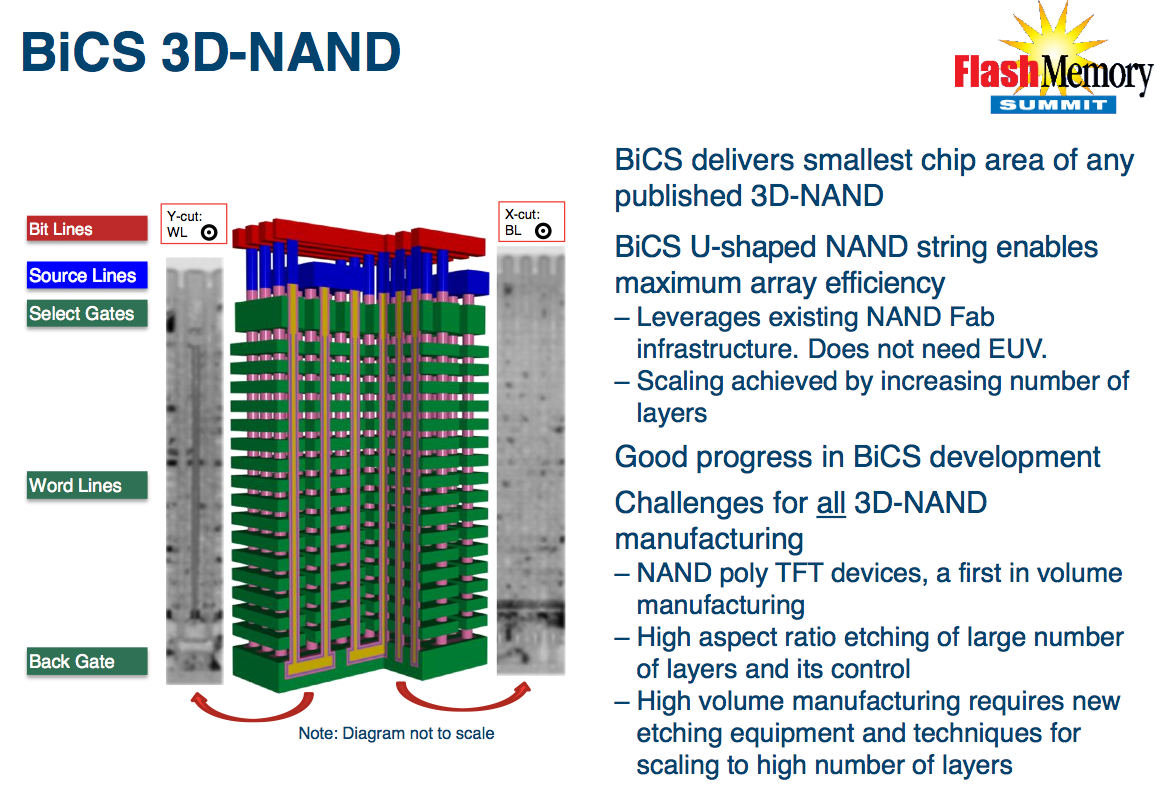
Toshiba calls its news 3D flash architecture BiCS (Bit Cost Scaling).
The new flash memory stores two bits of data per transistor, meaning
it's a multi-level cell (MLC) flash chip. It can store 128Gbits (16GB)
per chip. This diagram illustrates how Toshiba and SanDisk's BiCS 3D
NAND technology is structured. Starting in 2014, the rising price-performance
ratios of Samsung's TLC products have led to a rapid expansion of their
share in the system manufacturer market for PCs.
Additionally, SSDs that incorporate both 3D NAND and TLC technologies
have completed the client verification process in the first half of
2015 and are set to begin mass production and shipments in the second
quarter.
Shipments of TLC products will grow faster in the second half of 2015 when Intel Corp. introduces its latest processor platform, Skylake.
Hence, other SSD vendors will be in a hurry to develop their TLC-based
SSD products, and this in turn will drive the transition of NAND flash
production to the 15nm and 16nm processing technologies.
DRAMeXchange
expects TLC-based SSDs using NAND flash from suppliers besides Samsung
will be sent to PC manufacturers for testing in the third and fourth
quarter.
A push for faster interfaces
Intel is also becoming more active in ensuring its processors support different SSD architectures via different interfaces.
Another
bit of good news for users is that chip manufacturers are ramping up
production of higher speed interfaces based on the PCIe serial bus
standard. According to DRAMeXchange, PCIe SSDs are steadily making
inroads in the market that is dominated by interfaces belonging to the
mature SATA 3.0 technology.
Both the MacBook Pro and MacBook Air
laptop models adopted PCIe in 2014, encouraging other PC-manufacturers
to design products with the same interface and urging NAND flash
suppliers to develop SSDs that match the application.
The market
penetration of PCIe interfaces is expected to reach around 20% over the
next year, based on DRAMeXchange's projection.
With Skylake and
subsequent Intel processor platforms supporting SSDs with PCIe
interfaces, SSD controller chip vendors will roll out more related,
price-competitive integrated circuits. The SSD market therefore will see
a noticeable increase in the share of products with PCIe interfaces
next year.
A depiction of what an NRAM chip would look like.
Credit:
Nantero
NRAM has an almost infinite number of write cycles, and is thousands of times faster than flash
A new type of non-volatile memory known as Nano-RAM (NRAM) -- it's based
on carbon nanotube and sports DRAM speed -- is now being produced in
seven fabrication plants in various parts of the world.
According to Nantero, the company that invented NRAM, it also has more
than a dozen corporate customers lined up to begin experimenting with
the memory once it begins rolling off production lines.
"So those fabs have been and are indeed producing large numbers of
wafers and chips," said Greg Schmergel, CEO of Nantero. "They are sample
chips/test chips in preparation for mass production, which requires the
product designs to be completed."
Schmergel said it will likely take a couple more years before NRAM drives begin rolling off production lines.
Nantero
The geometric construct of a carbon nanotube.
"This is one of very few technologies that's moved beyond the research
lab into high-volume manufacturing CMOS facilities," Greg Wong,
principal analyst at Forward Insights, said in a statement. "NRAM's
unique combination of high speed and high endurance has the potential to
enable innovative products in a host of consumer and enterprise
applications."
NRAM has the potential to create memory that is vastly more dense that
NAND flash, which is used to make thumb drives and solid-state drives
today. The densest NAND flash process today is near 15 nanometers. NRAM
can reach densities of below 5 nanometers, according to Schmergel.
NRAM is up against an abundant field of new memory technologies that are
expected to challenge NAND flash in speed, endurance and capacity,
according to Jim Handy, principal analyst with semiconductor research
firm Objective Analysis.
For example, Ferroelectric RAM (FRAM) has shipped in high volume, IBM has developed Racetrack Memory, Intel, IBM and Numonyx have all produced Phase-Change Memory (PCM), Magnetoresistive Random-Access Memory (MRAM) has been under development since the 1990s, Hewlett-Packard and Hynix have been developing ReRAM also called Memristor, and Infineon Technologies has been developing Conductive-Bridging RAM (CBRAM).
"It’s really very difficult to project which horse will win the race to
become the replacement for NAND flash and DRAM in 2023 or so when we
anticipate that change, this juncture is so far off," Handy said.
Over the past two years, Nantero has been able to reduce NRAM production
costs 10-fold, making it compatible with complementary
metal-oxide-semiconductor (CMOS), the standard used for making
microprocessors and DRAM.
One big advantage NRAM has over traditional NAND flash is its resistance
to heat. It can withstand up to 300 degrees Celsius. Nantero claims its
memory can last thousands of years at 85 degrees Celcius and has been
tested at 300 degrees Celsius for 10 years. Not one bit of data was
lost.
Nantero
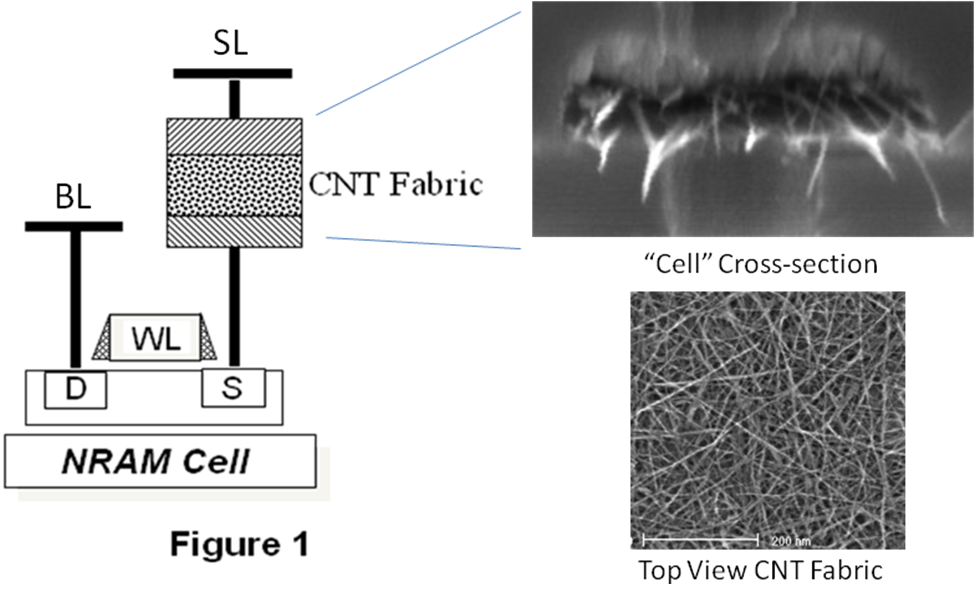
An illustration of the NRAM cell (left) and photos taken of the carbon nanotube fabric with an electronmicroscop (right).
Anpther advantage is that NRAM is being built using the DDR4
specification interface, so it could sport up to 3.2 billion data
transfers per second or 2,400 Mbps -- more than twice as fast as NAND
flash. Natively, however, the NRAM's read/write capability is thousands
of times faster than NAND flash, Schmergel said; the bottleneck is the
computer BUS interface.
"Nanotube switch [states] in picoseconds -- going off to on and on to
off," Schmergal said. A picosecond is one trillionth of a second.
Nantero
Carbon nanotubes are strong -- very strong. In fact, they're 50 times
stronger than steel, and they're only 1/50,000th the size a human hair.
Because of carbon nanotubes' strength, NRAM has far greater write
endurance compared to NAND flash.
The best NAND flash, with error correction code, can withstand about
100,000 erase-write cycles. According to Nantero, NRAM can withstand 1012 write cycles and 1015 read cycles -- an almost infinite number.
"Heat and vibration also will not cause errors," Schmergel said.
How NRAM works
Carbon nanotubes are grown from catalyst particles -- most commonly iron.
NRAM is made up of an interlocking fabric matrix of carbon nanotubes
that can either be touching or slightly separated. Each NRAM "cell" or
transistor is made up the network of the carbon nanotubes that exist
between two metal electrodes. The memory acts the same way as other
resistive non-volatile RAM technologies.
Carbon nanotubes that are not in contact with each other are in the high
resistance state that represents the "off" or "0" state. When the
carbon nanotube contact each other, they take on the low-resistance
state of "on" or "1."
Nantero
An illustration showing the two states of NRAM, where one carbon
nanotube is either touching another, creaing a low reisistance or "on"
state; the other, where the tubes are not touching, creating a high
resistance or "off" state.
Over the past few months, Nantero has hired more than a dozen chip
design engineers who are working to create high density circuits,
including three dimensional or stacked designs for increased capacity.
"If you're taking a gum stick, then your talking about many gigabytes of capacity -- terabytes in the future," Schmergel said.
Nantero doesn't plan on producing its own NRAM drives, which will
initially be marketed for purposes similar to solid-state drive (SSD)
gum sticks or internal memory boards. But it will license its
intellectual property to companies to develop their own product.
Nantero's engineers are still in the process of creating chip designs
for the memory wafers.
Because of its resilience to heat, vibration and pressure, Nantero's
carbon nanotube memory has caught the eye of aerospace giant Lockheed
Martin and Schlumberger Ltd., the world's largest gas and oil
exploration and drilling company; both companies are customers of
Nantero.
Nantero declined to name its other customers.
"Clearly a company like [Schlumberger] would have need of memory that
could perform in environments with very high heat down in an oil well,"
Schmerge said.
Founded in 2001, Nantero has to date generated $78.1 million in five
rounds of funding, including a series E round for $31.5 million that it
just closed. The company also announced that the former vice president
of Intel's Flash Memory Group, Stefan Lai, has joined the company as a
technical advisor. Lai co-invented the EPROM (erasable programmable read
only memory) flash memory cell and led the Intel's phase change memory
(PCM) development team.
"Nantero's NRAM has unique attributes that make it the most promising
candidate to be the almost ideal memory: the nonvolatility of Flash, and
the speed and functionality of DRAM with lower cost," Lai said.
Nantaro also announced that Yaw Wen Hu, a former executive vice
president at Inotera Memories, has also come on board as a technical
advisor. Inotera, a Taiwan-based partner of Micron, supplies nearly 10%
of the world's 300mm DRAM silicon wafers at its two fabrication
facilities.
"The availability of memory technology that is extremely fast, can
deliver terabits of storage capacity in the future and consumes very
little power, has the potential to change the future of electronics,"
said Alan, Niebel, CEO of Webfeet Research. "After researching NRAM for
over twelve years, WebFeet applauds Nantero for reducing the costs of
the CNTs in an NRAM chip by 10x in the last two years, making NRAM CMOS
compatible and finally proving NRAM viability with commercial production
capability from its licensees."


 Toshiba
 Toshiba
 Nantero
  Nantero
  Nantero
 Nantero
  Nantero
  Nantero